
Chinese Herbal Medicine for Menopause: What a Practitioner Actually Prescribes
The Chinese herbs most used for menopause are multi-ingredient formulas, not single herbs. Common ones include Liu Wei Di Huang Wan and Zhi Bai Di Huang Wan for hot flashes, Suan Zao Ren Tang and Tian Wang Bu Xin Dan for sleep, and Xiao Yao San for mood. Which you receive depends on your diagnosed pattern, not your symptoms.
That last sentence is the difference between a prescription and a purchase. Search for Chinese herbs for menopause and you will find research journals that will not tell you what to do, and retailers that will happily tell you what to buy. Almost nobody explains what happens when a licensed herbalist prescribes for you, or why it produces a different result from taking the top-reviewed bottle.
What Chinese herbal medicine is, and what it is not
Chinese herbal medicine is a prescribing system, not a product category.
A practitioner-prescribed formula contains multiple ingredients in defined roles. A chief herb addresses the primary pattern, deputy herbs support it, assistant herbs moderate side effects or treat secondary complaints, and an envoy directs the formula's action to the intended part of the body. Change one ingredient and it becomes a different prescription with a different name and indication.
What it is not: a supplement aisle. The blends sold online with menopause on the label are usually a classical formula at a fixed ratio, sold to everyone regardless of pattern, and never adjusted. Some people do well on them. Many take a formula suited to a pattern they do not have, feel nothing, and reasonably conclude Chinese herbs do not work.
It is not a substitute for your physician's care, and it is not hormone replacement. An herbal formula is not prescribed as a source of estrogen or progesterone.
How a practitioner decides what to prescribe
The process is called pattern differentiation, and it is diagnostic rather than a lookup table. A first consultation has three parts.
Symptom intake. When the flashes occur, whether you sweat at night, how you sleep and at what hour you wake, energy, digestion, thirst and temperature preferences, emotional state, menstrual history, and every medication and supplement you take.
Tongue assessment. The tongue body, its coating, and its moisture, each of which maps to different internal patterns.
Pulse assessment. Taken at three positions on each wrist, assessing depth, rate, strength, and quality.
From that, a pattern is named. Two women arriving with the same complaint routinely receive different formulas.
Consider two patients who both report hot flashes. The first has night sweats that soak the sheets, wakes around three in the morning, has a dry mouth, a red tongue with little coating, and a thin rapid pulse. That is yin deficiency with rising deficient heat, pointing toward the Di Huang family of formulas. The second flushes under stress, holds tension in her ribs and jaw, alternates between irritation and tears, and has a wiry pulse. That is liver qi stagnation, pointing toward Xiao Yao San. Same symptom, different diagnosis, different herbs.
This is also why the formula changes over time. Perimenopause is a moving target, and a formula that fits your pattern in March may not fit in June. A formula that is never adjusted is a product, not a prescription.
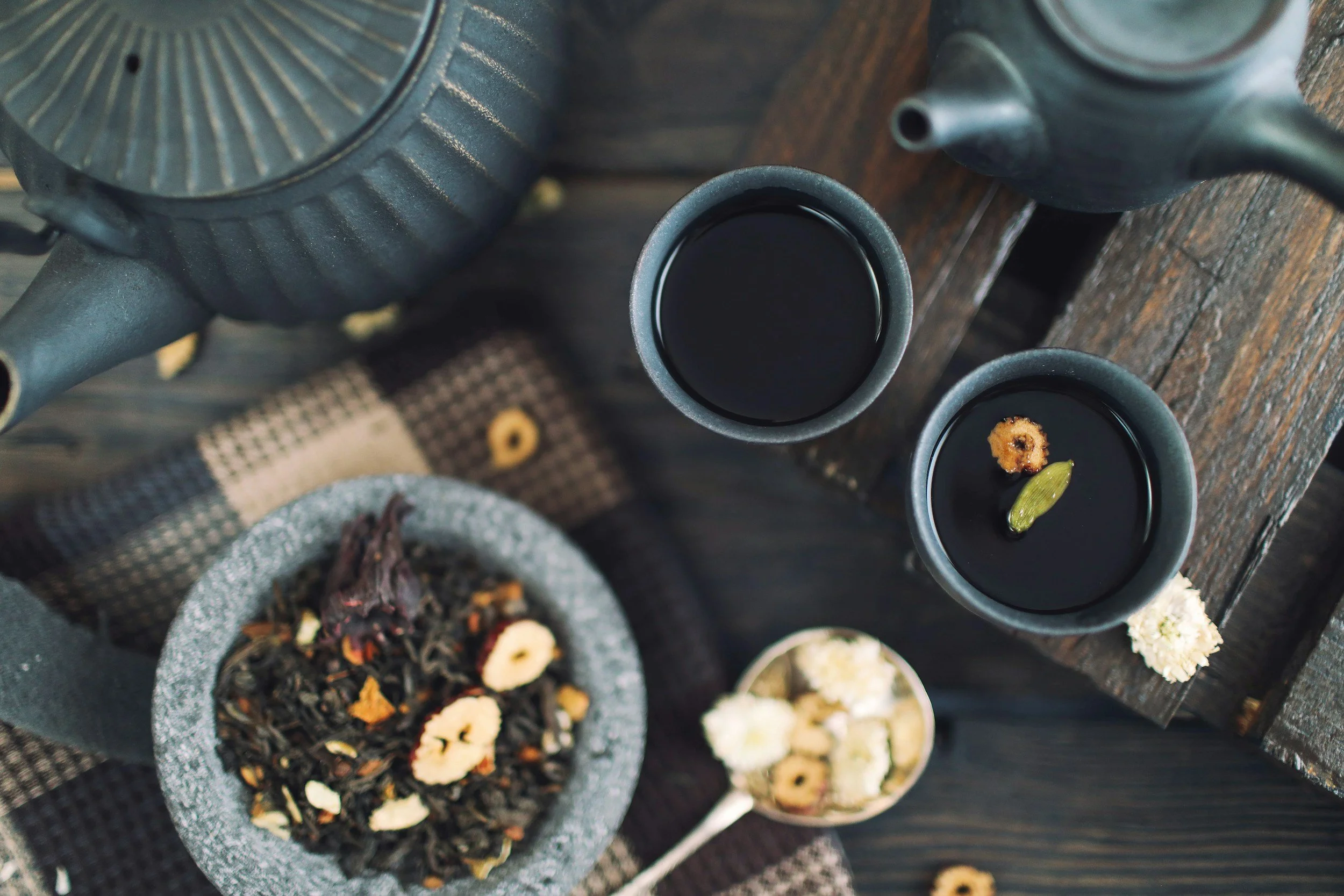
The formulas most often used for menopause symptoms
These are the classical bases most commonly drawn on, each modified for the individual rather than dispensed as written.
Two entries are worth a note. Er Xian Tang is often described as ancient. It is not. It was developed in Shanghai in the early 1950s specifically for menopausal syndrome, the only formula here purpose-built for the condition rather than adapted to it. And zang zao, the condition Gan Mai Da Zao Tang treats, covers emotional lability, unexplained weeping, and restlessness in women, a strikingly accurate account of what many patients report during the transition
Do Chinese herbs work for menopause
Here is the answer, and the order in which it should be read.
Clinical trials of Chinese herbal medicine routinely test one fixed formula against a symptom in a mixed group of women. That is the opposite of how the medicine is practiced. Testing Zhi Bai Di Huang Wan on a cohort where only some patients have that pattern would struggle to show a benefit even if the prescribing model works perfectly.
With that in mind, the headline finding. A Cochrane systematic review of twenty-two randomized trials covering 2,902 women concluded there is insufficient evidence that Chinese herbal medicines are any more or less effective than placebo or hormone therapy for relief of vasomotor symptoms, and that effects on safety were inconclusive. Evidence quality ranged from very low to moderate.
We are not going to tell you otherwise in order to sell you a formula.
That finding does not mean the trials proved herbs ineffective. It means the trials were not good enough to settle the question. It does mean no one should promise that a formula will reduce your hot flashes by a specific amount.
So what is honest to say?
Chinese herbal medicine has a documented tradition of use measured in centuries, an established prescribing logic, a low but real rate of reported side effects, and clinical results we see in practice. What it does not have is high-quality trial evidence that it beats placebo. If you require that standard before trying something, this is not the right treatment for you, and we would rather say so now.
Can Chinese medicine delay menopause?
No. Menopause is the exhaustion of ovarian follicular reserve, and no herbal formula reverses or postpones that. Chinese herbal medicine is used to make the transition more livable, not to prevent it.
Safety, and what to tell your prescribing physician
Chinese herbs are pharmacologically active. That is the point of them, and it is also why they require care.
Reported side effects in the reviewed trials were mostly mild: loose stools, breast tenderness, stomach discomfort, and an unpleasant taste. Two risks matter more.
The first is product quality. Chinese herbal products from unregulated sources have been found contaminated with undeclared pharmaceuticals, heavy metals including arsenic, lead, and cadmium, pesticides, and in some cases substituted or misidentified herbs, some of which have caused organ damage. That is a sourcing problem rather than a medicine problem, and it is the strongest argument for obtaining herbs through a licensed practitioner who sources from tested suppliers.
The second is interaction with medication. Tell your prescribing physician that you are taking Chinese herbal medicine, and tell your herbalist everything you take. The categories warranting particular attention:
Anticoagulants and antiplatelet drugs, including warfarin
Immunosuppressants, including cyclosporine
Cardiac medications, including digoxin
Cancer chemotherapy agents
Antidepressants, particularly serotonergic ones
Blood pressure medications, including calcium channel blockers and beta blockers
Statins
Diabetes medications, including metformin
Hormone therapy and oral contraceptives
Sedatives and benzodiazepines
This list is not a warning against herbs. It is the disclosure conversation any competent herbalist initiates at your first visit. A practitioner who does not ask what you take, or who discourages you from telling your physician, is a practitioner to leave.
Herbs alongside acupuncture
Many patients here receive both, and in our clinical experience they do different jobs.
Acupuncture is episodic and works through the session. Herbs work continuously between sessions, which matters most for symptoms occurring when you are not in the clinic, meaning night sweats and three a.m. waking. Herbal formulas are frequently what maintains a result once acupuncture frequency steps down.
A common structure: acupuncture twice weekly for the first two weeks and then weekly through session eight, alongside an herbal formula reviewed at each visit, then acupuncture stepping down to monthly with the formula continuing.
Read more about the acupuncture side in our guides to perimenopause and menopause care and how acupuncture supports hormone balance.
Booking an herbal medicine consultation
Herbal medicine is offered at Grace Family Acupuncture alongside acupuncture. An herbal consultation covers the full intake, tongue, and pulse assessment described above, because a formula cannot be prescribed without them.
Care is provided by Dr. Yang Gong, DTCM, L.Ac., Founder and Senior Clinician, who has more than 30 years of clinical experience in acupuncture and herbal medicine, and Dr. Jing Gong, DAOM, Dipl. O.M., L.Ac., Managing Director and Principal Clinician, a fifth-generation Traditional Chinese Medicine practitioner and board certified acupuncturist and herbalist. The clinic has served Overland Park, Kansas and the wider Kansas City metro since 2002.
Frequently asked questions
-
The formulas most often used are Liu Wei Di Huang Wan and Zhi Bai Di Huang Wan for hot flashes and night sweats, Er Xian Tang where flushing occurs alongside genuine cold intolerance, Suan Zao Ren Tang and Tian Wang Bu Xin Dan for insomnia, and Xiao Yao San for stress-driven symptoms and mood. Which is right for you depends on your diagnosed pattern rather than your symptom name.
-
The most rigorous review available, covering twenty-two trials and 2,902 women, found insufficient evidence that Chinese herbal medicine is any more or less effective than placebo or hormone therapy for vasomotor symptoms, with evidence quality from very low to moderate. There is a long documented tradition of use and clinical results in practice, but the trial evidence does not establish superiority over placebo, and we will not claim it does
-
It is used for the symptom picture rather than for menopause itself: hot flashes, night sweats, insomnia, mood changes, fatigue, and dryness. It is prescribed alongside, not instead of, whatever care your physician is providing.
-
There is no single best formula, and that is not evasion. The formula that helps one woman substantially will do nothing for another with an identical symptom list but a different underlying pattern. The best formula is the one matched to your diagnosis and adjusted as your presentation changes.
-
It is a reasonable option if you want a non-hormonal approach, have symptoms hormone therapy has not resolved, or cannot take hormone therapy. It is not a reasonable option if you need treatment with proven superiority over placebo, because the current evidence does not support that claim.
-
No. Menopause occurs when ovarian follicular reserve is exhausted, and no herbal formula reverses or delays that process. Chinese herbal medicine is used to make the transition more manageable, not to postpone it.
-
It is individualized prescribing of multi-ingredient formulas based on a diagnosed pattern rather than a symptom label. The formula is reviewed and modified between visits as your symptoms change.
-
Largely the same formula families as for menopause, weighted differently. Perimenopause more often presents with cycle irregularity, stress-driven flushing, and mood volatility alongside early vasomotor symptoms, so liver-regulating formulas such as Xiao Yao San and spirit-calming formulas such as Gan Mai Da Zao Tang feature more prominently than in later postmenopausal prescribing.