
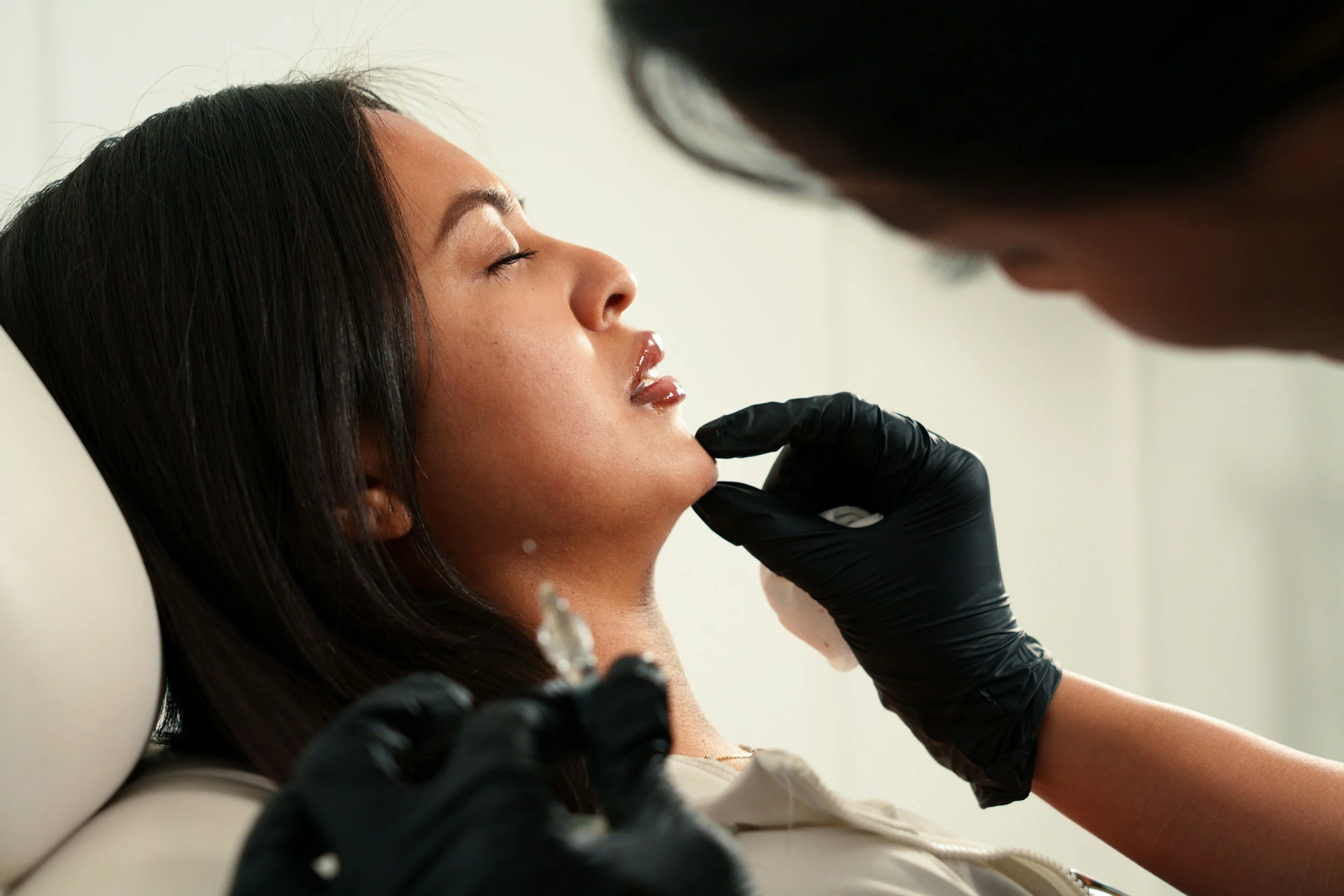
For some people, acupuncture can ease the muscle tension behind TMJ headaches: the aching temples, tight jaw, and stiff neck that come from clenching or grinding. It aims to release the overworked chewing muscles, treats the neck and shoulders that tighten with them, and works alongside the jaw habits and dental care that matter just as much.
If you wake with a headache at the temples, carry a neck that never quite loosens, and clench your teeth when you are busy or stressed, those three things are often one pattern, and it is the pattern Dr. Jing Gong and Dr. Yang Gong look for first at our Overland Park clinic.
How TMJ tension causes headaches
TMJ problems, properly called temporomandibular disorders or TMD, are twice as common in women as in men, especially women between 35 and 44.
The headache link runs through the chewing muscles. The temporalis is a fan-shaped muscle that spreads across the side of your head; the masseter is the thick muscle you can feel bulge at the angle of your jaw when you bite down. When clenching or grinding overworks them, the temporalis refers pain to the temple. A headache from TMD is usually felt at the temples, on one or both sides, and gets worse with chewing, clenching, or grinding. It overlaps heavily with tension-type headache, and in practice many people have both.
Signs your headache is coming from your jaw
Your temples ache, and the ache is worse after chewing gum or tough food.
You clench or grind your teeth, by day or at night, and the headache tracks it.
Pressing on the muscle at your temple reproduces the headache.
Your jaw feels stiff, clicks painfully, or occasionally catches or locks.
Clicking on its own, without pain or locking, is common and usually not a concern.
How acupuncture treats TMJ and jaw tension

Acupuncture treats TMJ and jaw tension by releasing the muscles that drive the clenching. A fine needle placed in a tight muscle prompts it to let go and improves blood flow to tissue that has been held contracted for hours. Treatment starts with finding which muscles are carrying the load and what is driving the clenching, then works on three levels:
Local points around the jaw and facial muscles, to release the masseter, the temporalis, and the tension at the temples.
Distal points on the hands, feet, or elsewhere on the body, as part of a broader plan for the pattern behind it. LI4, in the web of the hand, is a classic point for face and jaw pain, avoided in pregnancy.
Neck and shoulder treatment when those muscles are tight too.
When neck and shoulder tightness is part of the picture, cupping may be added to those muscles. It is not usually applied to the jaw or face.
In Traditional Chinese Medicine, the Stomach channel runs along the jaw up to the temple, the Gallbladder channel runs over the temple and down the side of the neck, and stress-driven clenching is read as Liver Qi stagnation: tension that has nowhere to go and settles in the jaw. We also cover the habits that keep the jaw loaded: stress, how you rest your jaw during the day, gum chewing, and unconscious clenching. A simple cue: "lips together, teeth apart." Check it at your desk or at a red light on your drive home.
On the evidence: research on acupuncture for TMD is still limited, and it does not help everyone. Some TMJ problems are muscular and may respond well; others involve the joint itself and need a different approach or a dental assessment.
TMJ, neck tension, and headaches
Can TMJ cause neck pain? Yes. TMD pain often spreads into the face and neck, and neck tension and jaw clenching tend to feed each other. Clenching, a tight neck, and a tension headache tend to arrive together, especially under stress.
We treat them together rather than one at a time. If your headaches start at the back of your head rather than your temples, read our guide to neck pain and tension headaches. For tightness across the shoulders and upper back, cupping for neck tension can be part of the plan.
What a course of treatment looks like
Your first visit is a full 60 minutes. We take a complete history, identify which jaw, temple, and neck muscles are tight or tender, and ask about sleep, stress, and grinding. Treatment starts in the same visit.
From there, treatment begins with an initial course, and we reassess at the end of it. If things are not changing, we change the plan or send you back to your dentist, rather than booking open-ended visits.
Working alongside your dentist
Acupuncture does not replace your dentist; it works best alongside dental care. The usual advice for TMD is to start with conservative, reversible care: soft foods during a flare, heat or cold, gentle jaw exercises, and cutting back on clenching and gum chewing. A night guard or stabilization splint from your dentist does not change your teeth or bite, and it can be used alongside acupuncture. Treatments that permanently change your teeth or bite should not be the first step.
See your dentist or physician first if your jaw locks open or closed, you cannot open your mouth normally, you have tooth pain or a dental problem, or your symptoms keep getting worse.
TMJ care in Overland Park
At Grace Family Acupuncture on West 98th Terrace in Overland Park, TMJ and jaw tension care is provided by Dr. Jing Gong, DAOM, Dipl. O.M., L.Ac., a fifth-generation Traditional Chinese Medicine practitioner and board-certified acupuncturist, and Dr. Yang Gong, DTCM, L.Ac., whose more than 30 years of clinical experience include hospital sports-medicine work. Every visit is a full 60 minutes, one-on-one, for patients across Overland Park, Leawood, Olathe, Lenexa, and Prairie Village. You can see the other conditions we treat on our acupuncture for pain relief in Overland Park page.

Here is what happens next:
Book your consultation online through our secure scheduling system.
Complete a 60-minute first visit with a full health history and an assessment of your jaw, temples, and neck.
Receive a personalized plan that covers the jaw, the headaches, and the habits behind them.
Begin treatment, with progress reassessed at the end of the initial course.
Book your consultation online and treat the jaw tension behind your headaches.
Frequently asked questions
-
It can help the muscle tension and pain of TMD for some people, especially when clenching and stress drive the problem. The research is limited, and it works best as part of a plan that includes jaw habits and, where needed, dental care.
-
It varies with how long the problem has been there and whether it is muscular or joint-related. We start with an initial course and reassess at the end of it.
-
Acupuncture needles are solid and very fine, set in through a thin guide tube, nothing like a dental injection. Most people feel a small pinprick at most, then a dull, heavy sensation in the muscle as it releases.
-
Yes. Overworked chewing muscles, especially the temporalis at the side of the head, refer pain to the temples. These headaches usually get worse with chewing, clenching, or grinding.
-
Yes. TMD pain often spreads into the face and neck, and neck tension and jaw clenching tend to feed each other.
-
Many TMJ problems are short-lived and settle with conservative care. Some become long-term and need ongoing management of the habits and tension behind them.
